01302 203 888
Free Delivery on all orders

If you’ve ever looked closely at a new tyre before fitting it, you might have noticed small coloured dots, most commonly red and yellow. This guide clearly explains:
Modern tyre manufacturing creates small variations in weight and shape, even when the tyre is built to strict tolerances. Because of this, manufacturers use dots to indicate special balance points or manufacturing high points.
These red and yellow dots are balancing dots that help tyre fitters mount tyres in the most optimal position for balance and performance. If these dots are aligned, you will reduce the amount of weight required for balancing. The less lead weight used, the lower the cost of wheel balancing.
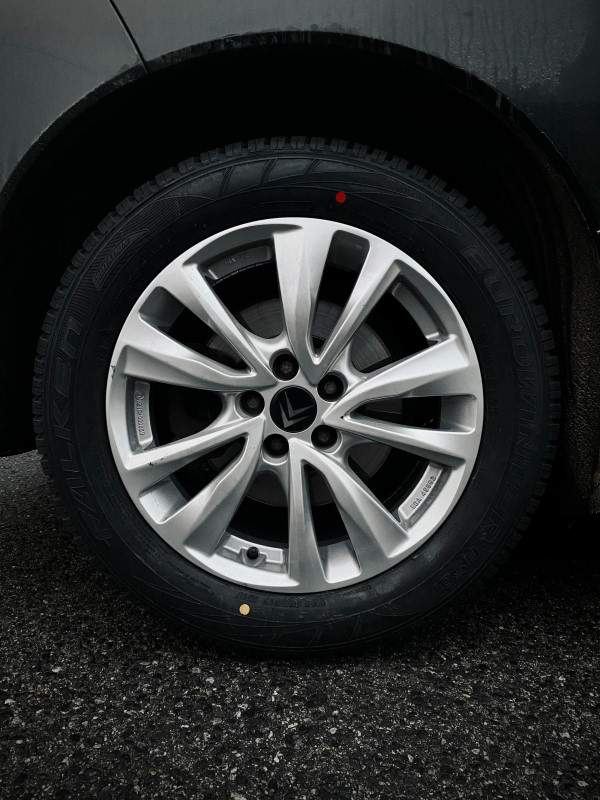
The yellow dot is placed where the tyre has the least weight. It indicates the tyre’s lightweight point. It is also called the low point dimple or “light static balance point”.
When the tyre is spinning, the force on the tyre and wheel when fitted will be at its lowest at the point of this yellow dot.
When matching tyres to wheels, fitters will typically align the yellow dot with the wheel’s lowest point, known as the valve stem. As most wheels are heavier at the valve stem, aligning the tyre’s lightest spot (yellow dot) with the wheel’s heaviest reduces the amount of balance weights needed.
The yellow dot may be printed, drilled or marked out by a sticker to signify the tyre’s lowest and lightest point.
The red dot indicates the spot of the tyre’s high point. Sometimes referred to as the “radial force variation first harmonic maximum”.
When the tyre is spinning, the force on the tyre and wheel when fitted will be at its maximum at the point of this red dot.
The red dot is used when a wheel has a corresponding low spot or dimple. Matching these two ensures the tyre sits as evenly as possible on the rim.
The red dot may be printed, drilled or marked out by a sticker to signify the tyre’s highest and heaviest point.
If your tyre has both a red and a yellow dot, you can’t align both perfectly at the same time so one must take priority. The first step is always to check the wheel. If the wheel has a low-point dimple, align the red dot with that mark. If the wheel has no markings, then in most cases the red dot takes precedence over the yellow dot.
However, if there is no red dot, then the yellow dot should be positioned next to the valve stem.
These red and yellow dots should be looked for before using a tyre machine to mount the tyre, to ensure that the ideal balance is set up from the off, and before any balancing of the wheels is done using your wheel balancing machine, as this will ensure minimal wheel balance weights are required.

The tyre is designed to be slightly lighter in the lower area where the yellow dot is found, and the tyre rubber is slightly thicker at the top where the red dot is found.
On alloy wheels and motorcycle wheel rims, the valve stem marks the heaviest point of the wheel. Lining up the valve stem on the wheel rim with the lightest point of the tyre, it helps to balance the weight out in this area.
However, on steel wheels, there is a dimple or mark that designates this as the thinnest part of the wheel, therefore the lightest part of the wheel rim, and hence matching this up to the red dot, which is the heaviest part of the tyre, once again helps to balance the weight distribution.
Poor alignment of these dots may lead to:
Correct alignment of these dots helps tyres:
Just remember, the red dot indicates the heaviest point while the yellow dot indicates the lightest point of the tyre.
If you have any tyre-changing questions, please get in touch today on 01302 203 888 or using our online contact form.